

Acquire For Yourself a Model, Make For Yourself a Teacher
A Midrash about Cain and Abel explains Satya Nadella’s latest argument in favor of frontier ecosystems over frontier models


The first people to divide the world up, and establish private property, (according to Genesis) were Cain and Abel, murderer and murdered.
According to a famous Midrash, the two brothers split creation between themselves, one taking the land and one the “movables.” One takes the data centers and the chips, one takes the application layer, the workflows, forward deployed engineers. For a moment, the partition held. Then the one who owned the ground told the other that the dirt he stood on was his, and the one who owned the cloth told the first that the clothes on his back were his. In the Midrash, Cain and Abel are not named, perhaps because it holds both culpable for their souring relationship, their failure to collaborate and form a virtuous ecosystem.
This one said strip, and that one said scram (Genesis Rabbah 22:7).
There was nowhere to stand that one did not own, and nothing to wear that the other did not own.
Out of that crossing of claims, Cain rose against Abel and killed him.
This is a nightmare scenario in which AI infrastructure companies and AI application companies fight to the death; or else, it is a cautionary tale about the potential conflicts between sovereign nations and companies when the stakes run high, as the recent Mythos story illustrates. (Another Midrash retells that Cain and Abel both owned land, but debated who would own the land on which the Temple is built; this is akin to base model companies competing to be the first to achieve AGI).

Dario finds out he’ll have to revoke consumer use of Fable (parody)
A company’s learning loop is movable; it is the traces, the tuning, and the judgment a firm can carry.
The model underneath it is land; it is the substrate the loop must stand on, the compute it cannot leave.
As we rush to partition this new world, we are told that owning the loop will save us. But a world divided strictly into property is unstable wherever the claims cross, and rigged wherever they do not.
We know how that story ends because we have played it out on an industrial scale before. Long before silicon chips, the tension between the movable craft and the unyielding substrate ground the birth of American aviation to a halt.
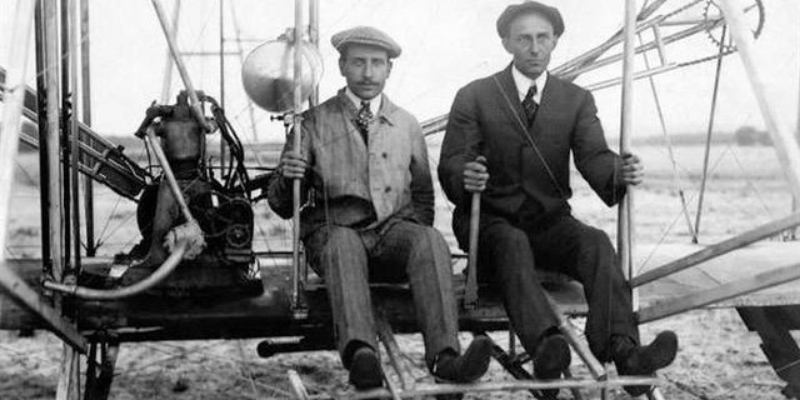
In the decade after they first flew at Kitty Hawk, the brothers who taught the world to fly had all but grounded American aviation, and it took the federal government to get it back into the air.
Wilbur and Orville Wright won a patent in 1906 on the thing they alone knew how to do, the steering of an aircraft in flight, and they spent what was left of their lives enforcing it. They sued Glenn Curtiss, they sued exhibition flyers, they sued importers, and the courts handed them everything, ruling that even Curtiss’s ailerons, a wholly different mechanism, fell under the Wrights’ patent on control of the air. A dozen lawsuits in, the industry had seized: the two largest patent holders blocked each other and everyone under them, so that when the United States entered WWI it could not build the aircraft it needed and fought in French and British machines. A government board finally herded the manufacturers into a single patent pool and cut the Wrights’ royalty from twenty percent to one. The men who gave the world the airplane had nearly kept the world from building one, by owning the discovery too well.
Yesterday, Microsoft CEO Satya Nadella, argued for an ecological view of AI: frontier labs must cultivate an open ecosystem for others to build upon, rather than consolidating the industry into a pyrrhic victory.

Practically, Satya offers this advice: Every firm would build two kinds of capital, human and token capital.
Human capital is the judgment and ingenuity and pattern-recognition of its people. Token capital is the artificial intelligence it builds and owns. The two compound, and human agency stays at the helm, because without human direction you have “compute running in circles.” The real prize is a learning loop on top of the models that gets better every time you use it, a hill-climbing machine that becomes the firm’s own IP. Meanwhile, the best models prove to be a commodity anyone can rent. His most memorable line - and one particularly resonant to me as a life-long learner and teacher - “You can offload a task, but you can never offload your learning.”
Satya is right.
In 2023 Bloomberg, spent a fortune training its own fifty-billion-parameter language model on a proprietary corpus no outsider could assemble, and never made a product of it, because a general model off the shelf that had never read a Bloomberg byte beat it on most financial tasks. The forty-year moat lived in everything except the model: the data, the workflows, the messaging network the whole Street uses as its nervous system and that no rival can swap into at any price. Tesla runs a hill-climbing machine whose millions of cars catch their own failures, retrain overnight, and ship the lesson back to the fleet by morning, so the loop steepens the longer it runs. Stripe runs it in payments, where a model trained on a trillion dollars of network traffic can tell you there is a ninety-two percent chance it has seen your card before. Meanwhile, Jasper, once worth 1.5b as a thin layer on someone else’s model, watched its revenue forecast fall by a third the year ChatGPT made the same capability free, because it had borrowed a model and never owned a loop.
Own the loop and a cheaper model is a gift.
Rent the model and a cheaper model is your obituary.
The macro current runs Satya’s way too. The price of a token of machine intelligence has been falling by something like a factor of ten every year, and over the same stretch enterprise spending on the things built from tokens climbed from under two billion dollars to thirty-seven billion. That is the Jevons paradox that I wrote about here.
The discovery that making an input cheaper explodes its use rather than shrinking it, because a thousand applications that were uneconomic at the old price suddenly pencil out.
Cheaper intelligence multiplies the number of places a person can stand and build a loop of his own. Falling model cost is the precondition for the many-winner world.
Yet Satya papers over what is called “the bitter lesson.”
In 2019, Richard Sutton, surveyed seventy years of artificial intelligence and found a graveyard. Every time researchers hand-built their human knowledge of chess or Go or language into a system, a more general method that simply scaled with raw computation came along and buried it. If that is the law, then the painstaking loop a firm encodes today is tomorrow’s BloombergGPT, and the company-veteran expertise Satya swears you will keep is precisely what the next training run, fed more of the world, quietly absorbs. Satya’s argument holds only where the loop’s signal stays outside what the frontier model can eat, and the bitter lesson says the frontier keeps eating inward.
Jewish tradition teaches that movable things can be stolen, that ownership passes the moment the owner despairs of getting them back, while land can never be stolen, because it never moves and can never be lost; it stays in its owner’s hand however many times it changes hands (Shulchan Arukh, Choshen Mishpat 371:1).
The bitter lesson rhymes with that law. A loop holds its value only where its signal is something the frontier cannot reach, a fleet on the road or a payment network, and for the median firm it is the movable half, thin or unexclusive, the thing the next model absorbs as it scales past it, while the land, the compute and the weights, sits where it always sat, in the vendor’s domain.
The half Nadella tells the firm to own is the half that can be carried off. And the numbers already show the rest of the field standing on rented ground: eighty-eight cents of every dollar enterprises spend on these models flows to just three of them.
Satya’s essay carries the tell. A platform owner who urges everyone to build their own loop, while he sells the cloud beneath every loop and bankrolls the model most of them rent, has read his Joel Spolsky, the programmer who in 2002 named the oldest move in the book: commoditize your complement, drive the price of the thing next to yours toward zero, so that all the value pools in the thing you sell. Make the model free and the landlord still owns the land.
By framing the future entirely around what can be built, owned, and rented, technologists treat intelligence as merely another asset to be partitioned. We assume that if we cannot own the infrastructure, we must double down on owning the expertise. But the rabbinic tradition suggests that this, too, is a categorical error. You cannot solve a crisis of zero-sum property by trying to propertize the human mind. Long before the corporation existed, the architects of the study hall realized that authority operates on a different syntax.
Make for yourself a teacher, acquire for yourself a friend (Pirkei Avot)
עֲשֵׂה לְךָ רַב, וּקְנֵה לְךָ חָבֵר
The teacher you have to make. The friend you have to acquire, buy, invest in. You cannot buy the teacher, because the instant a teacher has a price he answers to the one who pays, and an authority that answers to you has lost the one power that made it authority, the power to tell you no.
Token capital can be acquired. Authority cannot be owned.
The reason the loop alone cannot save the firm is geometric, and the kabbalists drew the diagram.
A loop is a circle, and a circle has no top. The Arizal, the sixteenth-century mystic of Safed, built his cosmology on two forms, igulim and yosher, circles and the upright line.
The circles are undifferentiated potential, equal in every direction, with no up or down, no nearer or farther from the source; what gives them an above and a below, an end and the means to it, is yosher, the straight line drawn in the figure of a standing man.
The model is igulim, vast equipotent capacity with no native sense of what is worth doing; the human is the yosher that gives it a direction. Leave the circle to itself and it optimizes, beautifully, toward whatever it was last told to value, which the economists call Goodhart’s law, that a measure adopted as a target stops measuring anything. The private evaluations a serious company now writes, the rubrics that grade a model against what the business actually cares about, are the attempt to hang a yosher over the igul, to make a rav for the machine. Sit down to write one and an hour in the floor tilts, because the machine can answer every line on the list faster than you can type it and cannot write the list, because a measure you set for yourself bends to whatever you wanted when you set it, and a measure that bends to you was never above you.
A frontier model wants to be the teacher. A frontier ecosystem is the arrangement that keeps it a chaver.
One institution has run that arrangement, at scale, across two thousand years, and it is the Jewish study hall, the Beit Midrash.
The oldest learning loop on record passed Nadella’s sovereignty test in the first century, in an argument over an oven.
Rabbi Eliezer, losing a vote on a point of law, called miracles to his side, a carob tree torn from the ground, a stream run backward, and at last a voice from heaven declaring the law was as he said. And Rabbi Yehoshua rose and said of the Torah, לֹא בַשָּׁמַיִם הִיא, “it is not in heaven” (Deuteronomy 30:12); we were commanded to follow the majority, and we take no dictation from a voice overhead. The law went against the miracles and against the voice. The bat kol is the frontier model speaking from outside, the most powerful source in the room, and the community had built its interpretive loop so completely that even a live revelation got no vote. Elijah later reported that God in that hour laughed and said, נִצְּחוּנִי בָּנַי, “my children have defeated me, my children have defeated me” (Bava Metzia 59b). That is the sovereignty test passed in its strongest possible form, and notice what it reveals the loop is for. The maker’s glory here is to be surpassed by the students he taught. The mesorah, the chain of transmission, is a loop that made itself independent of any single revelation, and the Giver concedes the point with delight.
And it distributed. For two thousand years the loop ran in thousands of local study halls at once, each with its own master of the place whose ruling bound his town, no one of them consolidating the others, the value flowing to the edges and staying there. This is the many-winner ecosystem Nadella can only promise, already built and stress-tested across exile and dispersion, and the tradition is explicit about the three things that kept it from collapsing into one authority or scattering into noise.
The first is a standard above every disputant that none of them owns, the majority and the method, the teacher over the loop. The second is chiddush, the daily obligation to produce something genuinely new from the inherited material; a house of study, the Talmud says flatly, cannot stand without it (Chagigah 3a), which puts the loop under daily orders to make something new. The third is that the asset is the transmission itself.
Satya wants a loop that is an advantage hard to replicate, and in the same breath an ecosystem where value flows broadly, and these are opposite instincts. The first is a moat. The second is a gift. And the study hall already rendered a verdict on the firm that tries to have both.
In the Temple there were two families, the house of Garmu and the house of Avtinas, who held the secret crafts of the showbread and the incense and would not teach them (Yoma 38a).
Their edge was real: when the sages replaced them with imported craftsmen, the substitutes came close and missed, and the incense of Avtinas rose in a column straight as a stick where the others’ smoke scattered. Their pricing power was real: the sages had to double their wages to bring them back. Their safety argument was real and is the exact argument the frontier labs make for keeping their weights closed, that an unworthy person might learn the craft and misuse it. And the verdict fell on them anyway. Of the craftsmen who taught freely the Mishnah says, the memory of the righteous is a blessing; of Garmu and Avtinas, who hoarded a genuine moat for genuine reasons, it says, the name of the wicked shall rot. The loop built never to be transmitted is named for rot even when its keepers are right about the danger and matchless at the craft. The court that passed that sentence had just doubled their wages rather than do without them, and it ruled against the men whose work it could not match. The curse falls on hoarding that pays, handed down by judges who had lost the bidding war and condemned the winners anyway. The maker’s glory, the tradition decided, is to be surpassed by the students he taught, and it chose that design with its eyes open.
So Satya is right that the moat is the loop a firm owns and the model is a rental anyone can swap; the cases confirm it and the bitter lesson only sharpens it. He is also right that there is room for more than a few winners, for the reason the economist Friedrich Hayek gave the central planners in 1945: the knowledge an economy runs on is dispersed across countless heads, local to time and place, and will not gather into one mind, or one model. And he is right to tell the firm to build with the machines rather than rent them. But a moat, by construction, keeps the water out, and the thing that actually distributes is the arrangement the study hall has run since before there were firms: a loop held in common under a standard no one owns, handed on faster than it can be hoarded.
Value flows broadly when you make the teacher and give away the craft, and it pools at the top when you wall the craft and rent the ground.
The Wright brothers walled the craft and grounded an industry; in 1993 CERN gave the World Wide Web away, into the public domain, so that no company could own it, and the open web buried the closed networks built to charge for the same thing. Nadella wants the many-owner loop and the moat at once, and the tradition that actually built the many-owner loop did it by surrendering the moat.
The two brothers had all of creation between them, the land and everything that moved across it, and they killed each other for want of the one thing neither could own. The firms are dividing the world again, the loop from the substrate, and calling the line a stable equilibrium. A firm can acquire the friend. But the teacher it has to make.
P.S. if you enjoyed this, you might enjoy our Great Books Library, Alexandria (www.alexandria.wiki), where you can read with an AI tutor in the book margins. Or Yochai (www.talktoyochai.com) - a new way to read Jewish texts.
 | A guest post by
|