

Everything in Its Place
A Philosophy of Preparation


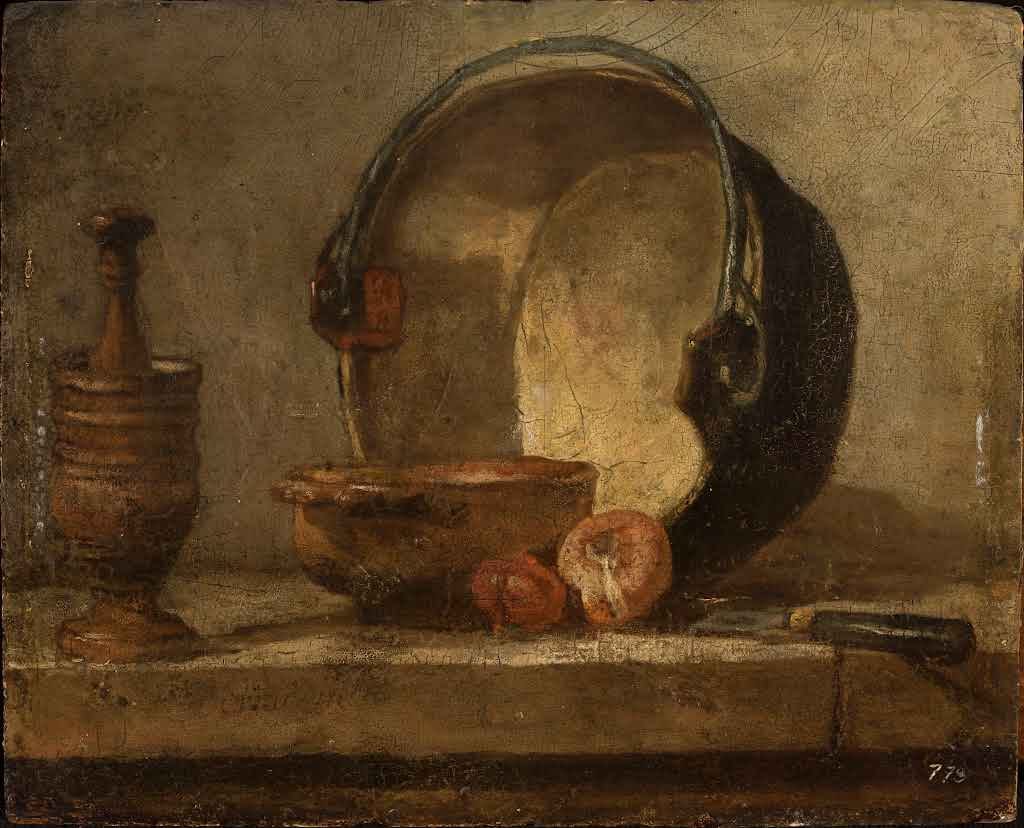
Still Life with Pestle, Bowl, Copper Cauldron, Onions and a Knife by Jean-Baptiste-Siméon Chardin
I was standing in the kitchen with my wife, making dinner. We were talking about Gilles Deleuze’s last essay, “Immanence: A Life,” written just before his death. What does it mean, I wondered, to create an essay that exemplifies your life, your conception of what life can be?
My hands were busy with prep work, arranging ingredients, clearing space. And suddenly I saw it: mise en place. The connection to Anthony Bourdain, to how he used this concept. But more than that, the acknowledgment that this organizing principle runs through everything. Through the school I opened, through my design work now, through the very act of preparing dinner while thinking about philosophy. Mise en place has been my practice.
In Kitchen Confidential, Anthony Bourdain writes about mise en place with an intensity that goes far beyond culinary technique:
“Mise-en-place is the religion of all good line cooks. Do not f*%$ with a line cook’s ‘meez’ — meaning his setup, his carefully arranged supplies of sea salt, rough-cracked pepper, softened butter, cooking oil, wine, backups, and so on. As a cook, your station, and its condition, its state of readiness, is an extension of your nervous system.”
An extension of your nervous system. Not a tool you use, but an extension of consciousness itself. The station becomes you.
He continues, “The universe is in order when your station is set up the way you like it: you know where to find everything with your eyes closed, everything you need during the course of the shift is at the ready at arm’s reach, your defenses are deployed.”
Bourdain describes a chef stepping behind the line during a rush, approaching a cook who’s falling behind. The chef presses his palm down on the cutting board - littered with peppercorns, sauce spatters, parsley bits, bread crumbs. He raises his palm so the cook can see the debris sticking to it. “You see this?” the chef asks. “That’s what the inside of your head looks like now.”
The outside reflects the inside. The station is consciousness made visible.
The phrase Mise-en-place comes from the military: “putting in place.” Before French cuisine adopted it, it described the positioning of troops, equipment, and supplies before engagement. Everything ready, everything positioned, so that in the chaos of battle you could find what you needed without thinking. The preparation creates the possibility of spontaneous action. The military origin lingers. There’s something about preparation that knows chaos is coming, and expects resistance.
When the phrase entered professional kitchens, it retained this martial precision. But it evolved into something more. Mise en place organizes time, motion, attention. It creates a field of readiness where you can work without friction, where your hands know before your mind does. The cook who has mise doesn’t think about where the salt is. The salt is already there, exactly where it needs to be, at the moment the dish requires it.
This is why Bourdain calls it a religion.
Bourdain carried this principle beyond the kitchen into everything he made. His writing had the same quality as his cooking - nothing extraneous, everything positioned exactly where it needed to be. Read Kitchen Confidential and you feel the mise. Each scene arrives with its ingredients already prepped: the characters, the setting, the sensory details, the emotional stakes. He knew where everything was with his eyes closed.
His television work showed the same architecture. Before filming, he researched obsessively - the history, the politics, the culinary traditions, the right people to talk to. All of it arranged beforehand so that when the camera rolled, he could move spontaneously through the scene. The preparation didn’t constrain the work; it freed it. Because everything was in place, he could follow where the moment led.
This is the paradox of mise en place: maximum preparation creates maximum spontaneity.
The station set up perfectly allows you to improvise. The nervous system extended into your tools means you can stop thinking about the tools and start creating. The concrete and the abstract stirred together, taking on a life of their own.
This is what brought me back to Deleuze that evening in the kitchen. His last essay, written in the final months of his life, explores what he calls “a life” - not my life or your life, but life as pure immanence, pure potentiality.
Deleuze was dying when he wrote this. He knew it. And rather than write about his life, he wrote about life itself as a kind of impersonal field, something that doesn’t belong to anyone but moves through everyone. The newborn who hasn’t yet become a particular person, the dying man who is no longer quite himself, these are moments when we glimpse life as pure potential, before or after it takes on a fixed form. A life is “complete power, complete bliss,” he writes. It’s the field of possibility before it crystallizes into any particular form.
Reading Deleuze alongside Bourdain, I began to see mise en place differently.
It’s not just preparation for work, but the creation of a field where life can manifest. When your station is set, when everything is positioned and ready, you’ve created the conditions for something to emerge that you couldn’t have planned. The prep work doesn’t determine what happens; it opens the space where immanence can occur.
Deleuze describes immanence as “a pure stream of a-subjective consciousness.” This is what Bourdain means when he says the station is an extension of your nervous system. You’ve arranged the material world so thoroughly that consciousness can flow through it without obstruction. Subject and object dissolve. There’s just the work, happening.
A cluttered station clutters consciousness. Life can’t flow because it keeps hitting obstacles.
When I opened a Montessori school, I spent weeks preparing the environment. Every material in its place on the shelf, at the child’s height, arranged left to right in order of complexity. The geometric solids here, the practical life materials there, the sandpaper letters positioned so children could reach them independently. Montessori called this the “prepared environment,” but it was mise en place by another name.
The principle is identical: arrange the physical world so carefully that consciousness can move through it freely. A Montessori classroom works because children can find what they need with their eyes closed. They know where the materials are. They can work without asking permission, without waiting, without friction between impulse and action. The preparation of the environment creates the possibility of self-directed learning.
Montessori understood what Bourdain’s chef understood: the outside shapes the inside. A chaotic environment produces chaotic thinking. An ordered environment - not rigid, but carefully arranged - produces focused attention. Order creates freedom. When everything is in its place, the child’s mind is free to explore, to concentrate, to follow deep interest wherever it leads.
This is why mise en place felt so familiar when I encountered it in Bourdain’s writing. I’d been practicing it for years, just in a different setting.
Back in my kitchen that evening, hands still moving through dinner preparation, I understood something about what Deleuze meant by a life. He was pointing to something more fundamental than biography or personal narrative: the organized field where life itself can emerge and flow freely.
Mise en place is one way to create that field. It appears in professional kitchens, in Montessori classrooms, in the practices of writers and designers - anywhere someone has discovered that arranging the external world affects the internal one, that preparation creates the possibility of presence, that order enables freedom.
It is what I aspire to create in my own way with Alexandria, a prepared environment for thoughtful engagement with the deep past.
What does it mean to organize life itself?
Maybe it starts with the acknowledgment that consciousness and world aren’t fully distinct. The cutting board is my mind made visible. To find my place in the world, I must place the world before me.
 | A guest post by
|
Beautiful! Mise en place as “the organized field where life itself can emerge and flow freely” resonates with the idea that it is not the things themselves but the relationships among them that truly are the fundamental field. Ultimately there are no things only relationships. For a mind-bending excursion into this alternative approach to our experience see Iain McGilchrist’s magnum opus, ‘The Matter with Things’.