

From Writer to Editor
Gordon Lish, Max Brod, Adorno, Walter Benjamin, and Stalin on AI Writing

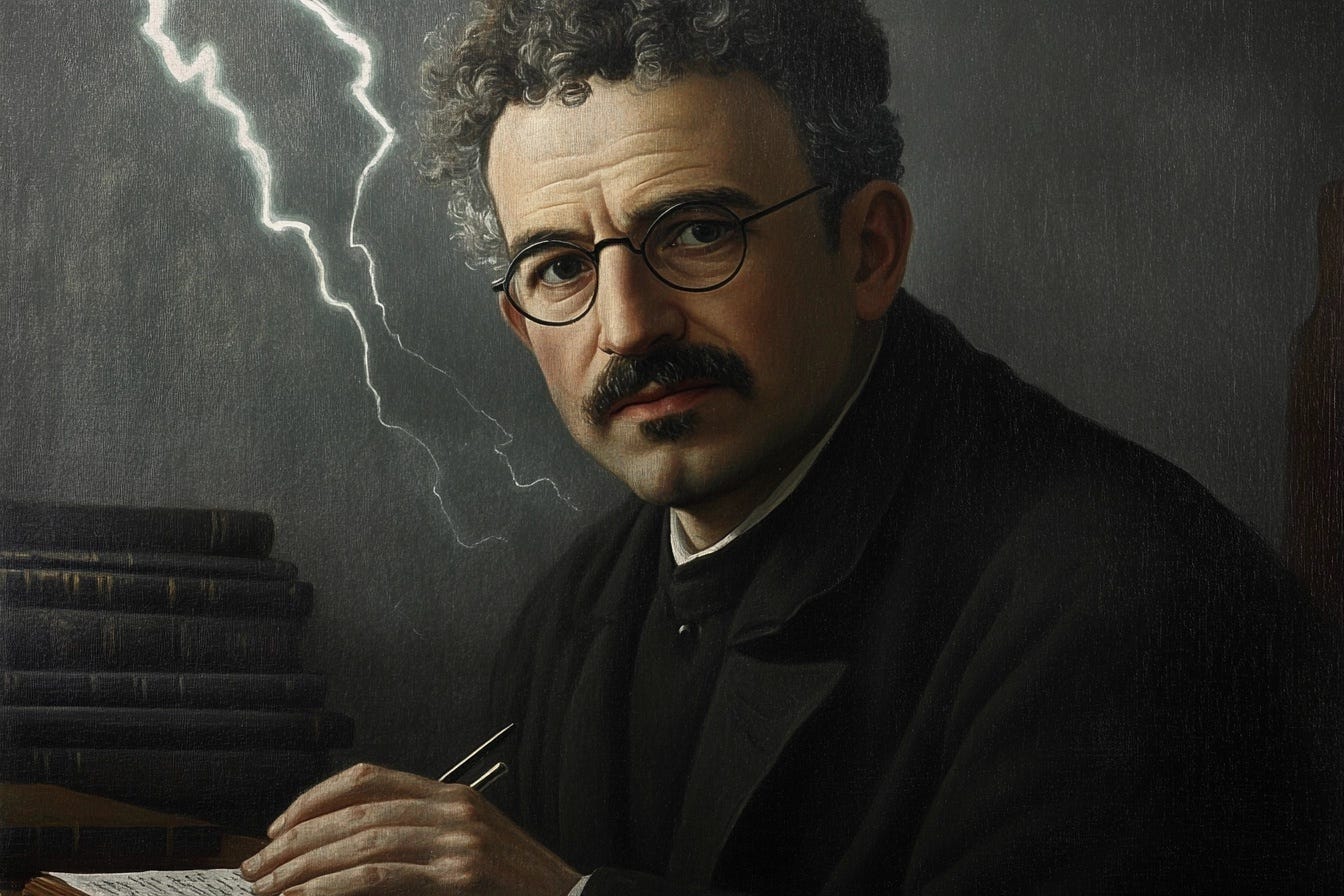
Every piece of published writing is the result of a dynamic between writer and editor. The writer gets the byline, but the editor wields the power of the red pen, and in some cases the power to hit “send.”
Sometimes an editor saves a writer. Famed editor Gordon Lish asks, “Had I not revised [Raymond] Carver, would he be paid the attention given him?” (Some say Lish edited Carver stories by up to 70%).
And sometimes an editor destroys a writer.
In this light, the arrival of generative AI is not inherently a demotion for writers; rather, it’s a promotion.
AI places us now in the role of editor. We are, or must become, Gordon Lish to its Raymond Carver.
The tension between the roles of writer and editor is archetypal, structural, and often fraught. Films like Whiplash and Clouds of Sils Maria demonstrate this agonistic dialectic.
Take the tragic case of Walter Benjamin. A philosopher of fragments, aphorisms, and constellations of thought, Benjamin was an eclectic genius, but also struggling itinerant (despite coming from money). His friend and sometime editor, Theodor Adorno, refused to publish several of Benjamin’s essays, and played a major role in rejecting his dissertation, on the grounds that his works insufficiently Marxist. Benjamin, stranded without an academic post, fled the Nazis and eventually took his own life at the Spanish border. Adorno exemplifies the the role that a toxic editor can play in a fragile life.
Contrast this with Max Brod and Franz Kafka. Kafka begged Brod to burn his manuscripts, at least according to legend. Brod refused. He edited, published, and preserved the strange, prophetic prose of his friend, against his friend’s own will. We are all beneficiaries of that betrayal. (Moral of the story: believe in the potential convexity of self-described junk).
Sometimes, an editor must say no not only to sloppiness but to shame and censorship.
Editors wield great power. Stalin knew this. Before he became a tyrant, he was a reader, a censor, a reviser of texts. The essay “Stalin’s Blue Pencil” documents Stalin’s meticulous and often brutal editorial interventions, shaping not only publications but history itself, a theme also taken up in Milan Kundera’s The Unbearable Lightness of Being.
Stalin’s pencil was blue because it didn’t show up on reproductions, but the hand behind it was always visible in what was left unsaid.
And yet editing can also be friendship. In Hebrew, the word for editor, m’chaber, shares its root with chaver; friend, companion. It is linked to chavruta, the study partner.
To edit is to bind: to make disparate pages speak, to connect paragraphs like people. Walter Benjamin, again, helps us here. In his vision of authorship, following Nietzsche (who viewed the self as an anthology of drives and voices) the writer is less an originator than a collector, assembling fragments and finding in their juxtaposition a new kind of meaning. Creation, Benjamin writes, is “not only the product of the solitary genius, but of a constellation of texts brought into relation.”
AI may be the fastest generator of fragments the world has ever known. But the question is not whether AI can write. The question is whether we can edit.
There is a temptation to treat this new tool as either savior or threat. But perhaps we should think of it as a wild writer under our editorial care.
Sometimes it rambles. Sometimes it surprises. Sometimes it hands you a line that sings. And sometimes it hands you trash. That’s not failure. That’s its job. AI puts out Hesed (creativity) so we can exert Gevurah (restraint).
In the Beat movement, Allen Ginsberg and Jack Kerouac celebrated spontaneity with the maxim “first thought, best thought.” No editing, just flow. In this sense, large language models are Beatniks at scale: they spill out unfiltered impressions, recombine the world’s ideas in jazzlike succession. But even the Beats, for all their anti-institutional bravado, needed editors. Lawrence Ferlinghetti at City Lights made Howl possible, not just by printing it, but by fighting the obscenity charges that followed.
Every movement that claims to transcend taste eventually runs into the reality of gatekeeping. Even John Cage, who invited silence and noise into music, had to decide when to end a piece.
The danger is not that AI will make writers obsolete, but that writers will forget they have always been already been editors, curators, collagists, choosers.
Herodotus, often called the father of history, described his work not as invention but as preservation—historia, inquiry, meant “saving from oblivion.” He was not just a chronicler but a collector. The first historian was an editor.
Today, every writer with access to AI holds the blue pencil.
We can use it to cut or to distort, to amplify or to erase. What will we preserve? What will we erase?
These are the questions Jewish liturgy imagines God asking on Yom Kippur, and popularized in Leonard Cohen’s Who By Fire.
God as Judge = God as editor.
To be human, we are told in Genesis is to be created in the divine image.
Now we know that to create, as God creates, is to edit.