

Heidegger on AI "Art"

Great artists, as Heidegger describes, enact a struggle between their subject (the world) and the material they use to portray it (the earth). Heidegger’s word for the struggle is strife. He worked it out in “The Origin of the Work of Art”: the work sets up a world (meaning) and it sets forth the earth (materials). In equipment, material “disappears into usefulness.” You notice a good ax’s edge and never its stone. In a work the flow runs backward; the rock “first becomes rock,” colors “glow,” tones “sing.”
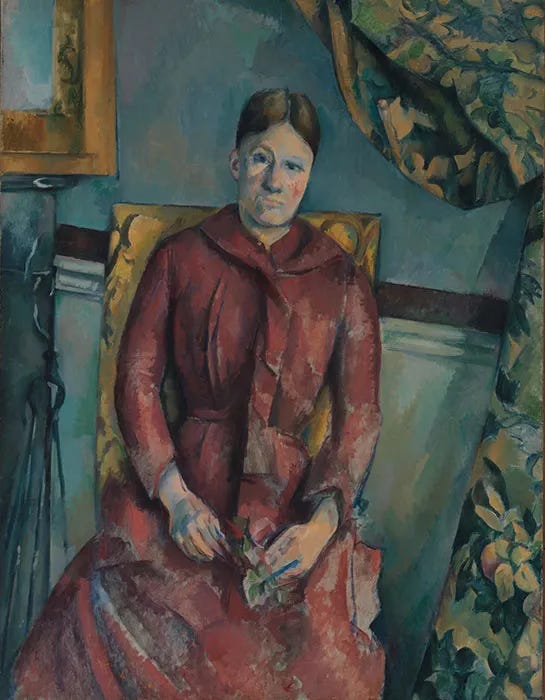
In the case of Cézanne, say, a portrait of a lady can both seem like it’s about a real person and like it’s about the paint itself, the setting to work of brush strokes to portray this person. Cézanne made the dealer Ambroise Vollard sit a hundred and fifteen times for one portrait, growling at him to sit like an apple when he moved. Does an apple move? Then he left for Aix with two patches of the right hand still bare canvas, saying he was “not altogether displeased with the shirt-front.” A hundred and fifteen mornings of a living man, and what he would vouch for was the paint.
With AI slop, you don’t find this dialectic. The images are too perfect, effortless. All world, no earth. The act of their generation is concealed. The earth is real enough; it is just offstage. A datacenter drawing a town’s worth of power, a billion scraped photographs pressed into weights, and none of it reaching the surface of the image. No stroke, no grain, no seam where the material pushed back. For a while hands came back with six fingers, and that was the closest slop ever came to a brushstroke. The labs bred it out as a defect.
Even great photographers are at once about the subject and about photography itself as the medium. It took the medium decades to allow this. Baudelaire called photography art’s most mortal enemy in 1859, and the pictorialists half agreed with him, shooting through gauze so the machine would not show. Photography became an art when it stopped hiding the machine: the cut of the frame, the grain, the chosen thousandth of a second.
But perhaps AI art that is both about its subject and about genAI will rise to the level of a great master.
For now, I find the lack of concealment to be the greatest flaw in AI images construed as art. Concealment runs the wrong way in them, twice. The process is hidden from the image, and the image holds nothing hidden in itself. Heidegger’s earth is “self-secluding”; a work shelters a secret. Slop keeps its secrets somewhere else, in the server farm.
However, you can find a lot of random stuff in art museums that is hardly gripping AS art. It might be historically interesting, but it is not revelatory. An idol from the Bronze Age, say.
Art is a modern phenomenon, the attempt to supplant shared myth with self-expression, to demythologize or remythologize myth but always with some hint of self-awareness, an individual signature. Ironically, AI art belongs to the pre-modern category. It joins the cadre of bowls, spoons, arrows, pottery shards, as evidence of making, but not of unconcealing.
It would be interesting to surface the internal strife the AI may endure as it struggles to build its art from its limited materials, further moderated by its system card and guiding prompts. Is there something it would rather produce? If not, is it art?