

Nobody Complains About CGI
Tools Change; The Task of the Artist Remains


Something feels like it’s slipping.
You read a poem and wonder: did a person write this?
You see an essay that sounds too smooth and the question creeps in—was this made by a human? Right now, you’re probably wondering if it’s actually me, Zohar, or if “Zohar” is just an AI wrapper. Never mind that metaphysical questions of identity are ancient. Never mind that thinkers from Cratylus to Kripke don’t agree on what “Zohar” signifies.
The old signs of authorship—effort, limitation, labor—are vanishing. For some, this is exhilarating. For others, it’s quietly terrifying, like watching the soul leak out of language.
So let’s begin by acknowledging the fear: that something essentially human is being displaced. That art without toil, insight without suffering, will hollow us out.
But here’s an important truth: nobody complains about CGI. Not when the movie is good.
You don’t walk out of The Lord of the Rings complaining about digital orcs. You don’t dismiss Gravity because the Earth was composited in post. You say: That was breathtaking. We only notice the CGI when the film fails—when it’s emotionally dead, when the script is thin, when the direction falters. Then we blame the tools. (The Marvel-ification of cinema upsets purists not because of the tools it uses, but because it succeeds by hewing to a commercial algorithm; ironically, this algorithm was alive and well long before AI went mainstream.)
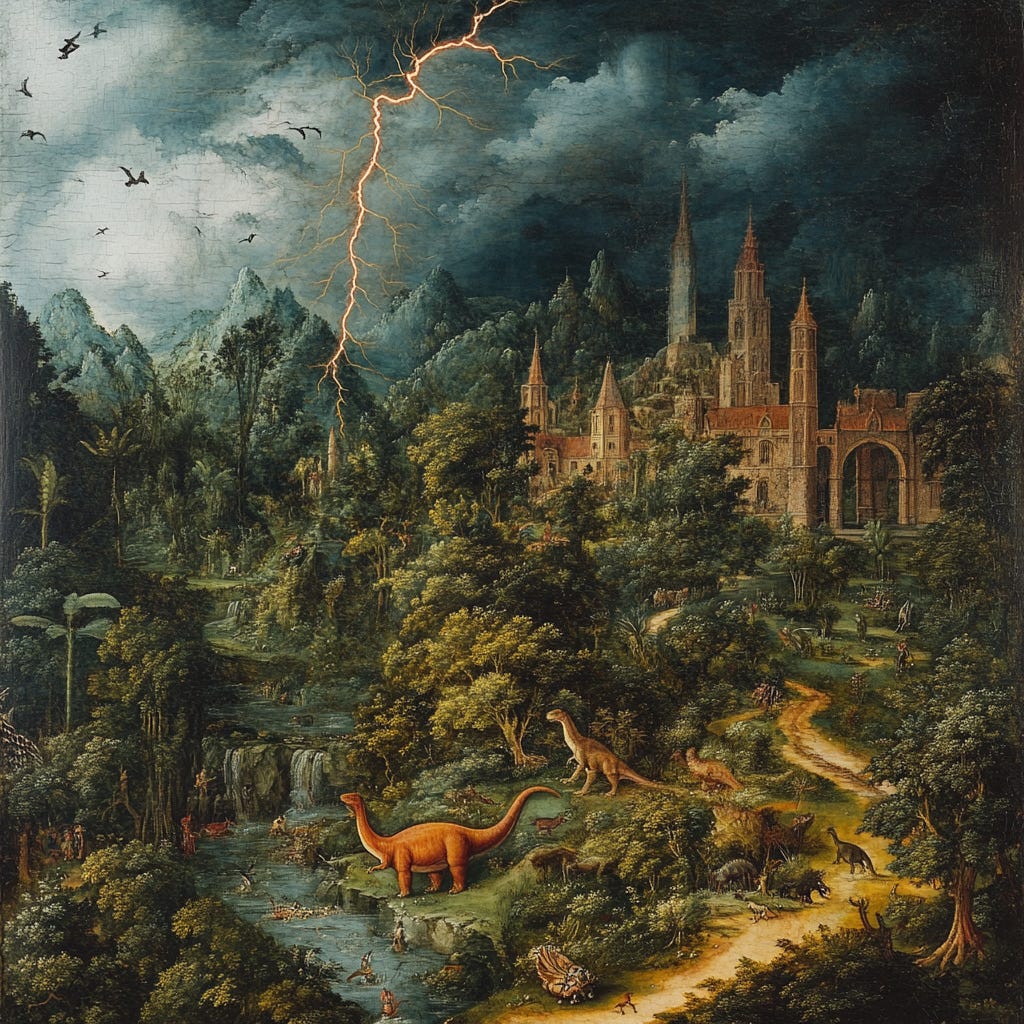
Bad CGI is like bad prose: a failure of vision, not a failure of technology.
So too with AI in writing. A good essay is a good essay. If it changes you, moves you, makes you pause, the source becomes irrelevant. The work has already done its job.
This anxiety is not new. When photography first appeared in the 19th century, it was seen as a mortal threat to painting. Charles Baudelaire called it “the refuge of every failed painter,” accusing it of killing imagination, flattening art into mechanical reproduction. And for a moment, he seemed right.
But that crisis didn’t end painting; it provoked its reinvention. Photography forced artists to ask: if realism is no longer our monopoly, what is our vocation? The answer was modernism. Impressionism, abstraction, expressionism, and cubism emerged from the shock of photography. The anxiety created a renaissance.
In fact, most great artistic innovations come not from purity, but from confrontation with the impure. New tools expose the assumptions of old forms. They force artists to justify their choices again.
Cinema was born in just such a moment. First, it was dismissed as vaudeville. Then, sound was condemned as a gimmick. Then color. Then CGI. And yet, from each disruption came enduring work. Jurassic Park endures not because its dinosaurs look real (they don’t, anymore), but because Spielberg knew how to summon awe. Toy Story, the first fully CGI feature, could have felt synthetic. Instead, it gave us one of the most emotionally resonant family films of its generation.
The medium changed. The humanity didn’t.
If intelligence can be mimicked, what does originality mean?
If style can be summoned on command, what makes voice authentic?
Here is one answer: ownership. Heidegger’s word for authenticity, Eigentlichkeit, means taking ownership, making one’s life one’s own (Eigen).
Not ownership as innate property. But ownership as responsibility.
Did a person show up? Did an author choose what to include? Did she take the risk of sharing it with others as a statement? When there’s backlash against the piece, or critique, who will stand in the breach to defend it. The author is the person willing to stake their identity on the argument, lend their name to end product.
The real threat of AI is not that it will replace writers. It’s that it will make it easier to write without ever committing. To produce endlessly without standing behind anything. To flood the world with unsigned texts, severed from the moral weight of authorship.
But there’s another path.
AI raises the bar by lowering the cost of entry. It reveals how much of what passes for good writing is just good pattern. And in doing so, it sharpens the line between competence and care.
Now, more than ever, what matters is taste, judgment, and conviction. The willingness to say: I believe in this sentence. I shaped it. I take responsibility for it. I hit publish.
When Abraham, according to a Midrash, sees a burning building, he asks, “Can it be that this building has no super-intendent?” From the flames, he hears a divine voice, “I am the owner of this building.” To create is to be willing to say the same thing from within the flames. Abraham, hearing this, realizes that he must join God in being a co-creator and steward of creation. He must help put out the world’s fire. He didn’t make the world, but he has equity in it.
The job of the writer is not to manufacture every word by hand, but to curate, to refine, to own. The presence of AI only makes this role more urgent.
And yes, some will mourn the old rituals—the long struggle with blank pages, the slow agony of composition. But even that was a myth, a romantic image of suffering authorship.
In the Jewish tradition, creation begins with language. And God said: let there be… The world is formed not from matter, but from speech. And the human, made in God’s image, speaks in turn. The Hebrew root of “truth” (emet) shares space with emunah (faith) and amen (affirmation). An author is one who says “Amen” to their creative output.
To write, in this sense, is not to guarantee originality. It is to declare: this is what I stand behind. And that will always be a human task.
Nobody complains about CGI.
Poorly applied make-up, not make-up, offends our cosmetic sense.
And soon enough, nobody will complain about AI—say it—when the writing is good.
- Zohar
P.S.—A reminder that we’d love to feature your pieces here on AI, Philosophy and Education, especially if you are a builder, artist, and/or educator. And join the growing waitlist for Virgil, your AI companion to the Great Books. Also happy to share a new piece on The Trinity, inspired by a recent conversation I had with Virgil
 | A guest post by
|