

The Interval
Revisiting Bernard Cache's Earth Moves


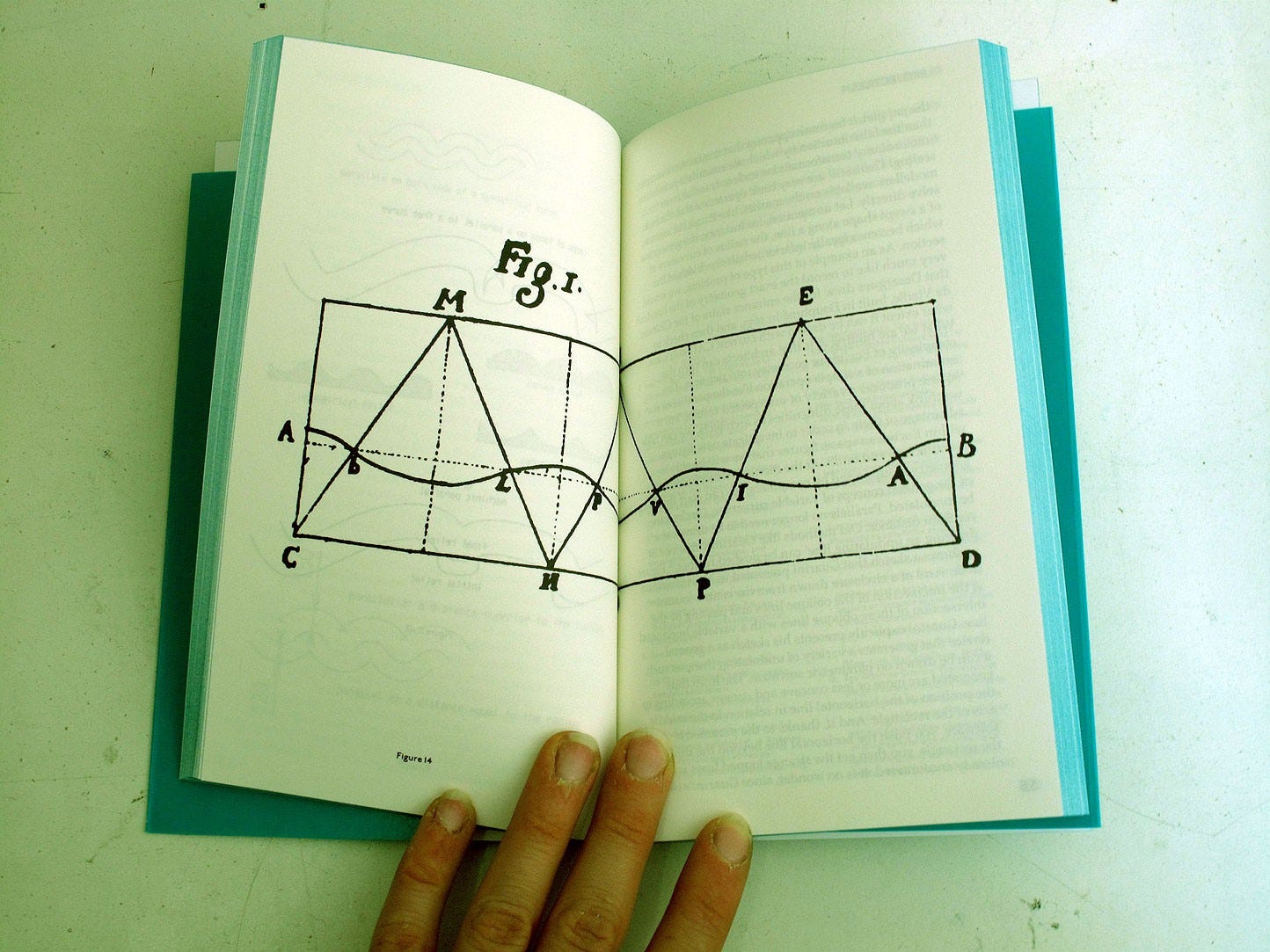
I found the printouts tucked inside the book. Pages printed from the early internet dated 3/1/01.
Twenty-five years ago, a younger me had been so arrested by Bernard Cache’s Earth Moves that he’d printed images and folded them into the pages: a painting by Francis Bacon, a map of a river valley in Lausanne, and Velázquez’s Las Meninas. The body, the territory, the frontal plane. Cache’s three great preoccupations, tucked inside his book without my knowing that’s what they were. I don’t remember doing this, although I remember the massive, noisy printers in the library. But opening the book now, the printouts fell out like a message from someone I used to be.
I returned to Cache not out of nostalgia but out of necessity. I had been looking for older tools to understand new problems. AI is reorganizing how we learn, how we remember, how we encounter knowledge, and the contemporary frameworks we reach for most readily seem inadequate to the depth of what is at stake.
I remembered Cache and Éric Alliez working in different registers — Cache architectural, Alliez metaphysical — both drawing on Gilles Deleuze’s reading of Henri Bergson. I thought: perhaps architecture can provide a scaffold, a mental model, a way of making the invisible legible by giving it shape.
Opening Earth Moves was transporting. Something in me recognized them before I could articulate what I was recognizing. This is precisely what learning at its deepest level feels like, I thought. And it is precisely what AI endangers.
Cache, following Bergson’s Matter and Memory, begins with an ontology that resists quick passage. The universe, in his account, is not a collection of objects but a field of images — everything in total luminous transmission with everything else, interactions propagating in all directions simultaneously. This is the default condition of reality: absolute transparency, total communication, light passing through light.
The body — your body, my body — is not a thing within this field. It is a gap in it. A zone of opacity. A place where the full pass-through of interactions is interrupted, where something receives more than it returns, where the transmission stutters. Cache, following Bergson, calls this indetermination: the condition of a response that is not fully determined by the present stimulus alone.
This is a radical inversion of how we usually think about bodies and perception. We imagine ourselves as receptors, screens upon which the world projects itself. But for Cache and Bergson, the body is better understood as a subtraction — a productive interruption in universal communication, a local escape from global conditions. Like a whirlpool in a river: not a thing added to the water, but a pattern of deviation within it.
What this opacity makes possible is the interval. The gap between solicitation and response. The moment of genuine waiting. And it is in this interval — this held-open space of not-yet-knowing — that everything interesting happens.
The body’s fundamental power, Cache argues, is the ability to wait. To insert a delay between stimulus and reaction. This sounds passive, even weak. It is the opposite. The interval is generative. It is where perception opens, where memory gathers, where genuine encounter becomes possible.
Think about what happens when you meet a text for the first time. Your usual automatisms reach for it and find nothing to grip. The normal pass-through fails. You are held in suspension, in what Cache calls the frontal dimension of perception: the image before you, clear in its articulation, its edges, its form. But simultaneously something else is occurring in what he calls the longitudinal dimension: the fabric of your entire history is folding against this new thing, resonating with it, vibrating at frequencies you cannot consciously track. The text is rubbing against everything you have ever read, thought, felt, lost, forgotten.
This is what inscription means in Cache’s vocabulary. The singular mark left by an encounter between this text and this body at this moment — shaped by everything you are, meeting this thing, now. It cannot be replicated.
AI promises, among other things, to close the interval at scale. To make the encounter with difficult knowledge frictionless.
The difficult concept becomes clear. The interval closes before it can inscribe anything.
If Cache and Bergson are right, then an AI that eliminates the interval is not accelerating learning. It is replacing it with something that resembles learning but lacks its essential character. Comprehension without inscription.
Cache thinks about the body as always being made — never finished, constantly modulating its limits in time and space. Memory is the faculty that makes the past the horizon of a variable present. The body is therefore not a fixed receiver but a dynamic field, perpetually renegotiating its relationship to the milieu through the tension between indetermination and automatism. What a building does is shape that negotiation. It creates conditions for encounter. It makes experience possible by structuring the interval, by creating the right kind of opacity.
This is what an AI guide for learning can do. Not close the gap, but hold it open. Not answer the question, but deepen the dwelling in it. Not make the text transparent, but help the body remain productively opaque to it for long enough that something singular can be inscribed.
The printouts dated 3/1/01 are themselves an argument.
Twenty-five years ago I encountered Cache’s Earth Moves and something happened that I could not have articulated then, something that left a mark I didn’t know I was carrying.
Now, reopening the book, those earlier marks are vibrating against new ones, the old resonance meeting the new situation, producing something that is neither the twenty-five-year-old’s reading nor simply the present one.
Learning is not the accumulation of content. It is the body’s ongoing negotiation with its own depth, its own contracted history, as new encounters arrive to disturb and reorganize it.
The question AI forces me to ask is whether I am building tools that honor this depth or tools that bypass it. Whether I am creating conditions for resonance or conditions for mere retrieval.
Cache ends his chapter on memory with a sentence I have been turning over since I found the book again: The body is therefore always to be made, as it constantly modulates its limit in time and space.
The body that learns is the body that waits, allows the encounter to leave its singular mark.
What resonates is what teaches. And resonance cannot be automated. It can only be made possible…
by waiting.
 | A guest post by
|
Terrific, Bobby! Articulates what I’ve been experiencing editing translations with assistance from Claude. It’s the gap between Claude’s input and my judgment that counts. Yes, everything turns over….
Another beautiful resonance with Iain McGilchrist’s “The Matter With Things”, a detailed look at the perception differences between our left and right brain hemispheres.
This passage also triggered a an important “aha” memory for me: “The interval is generative. It is where perception opens, where memory gathers, where genuine encounter becomes possible.”
As I read this in your piece I was transported back decades to my reading and practicing “Drawing on the Right Side of the Brain.” My favorite part was the suggestion that when trying to draw something complex from a photograph, such as a human face, turn the photograph upside down. The negative spaces and the unexpected shadows and shapes reveal depths heretofore unseen and unexplorable. Genuine encounter ensues as time melts away and the generated image triggers new memories and experiences.
Current AI seems quite left-brained. Our human advantage rests in our ability to leverage our cooperative holistic perception machine - our right hemispheres.
Perhaps we’ll need to engineer a corpus callosum to our AIs to fully leverage them, and vice versa.