

The Shape of Time
Education, Development, and the Ontology of Becoming


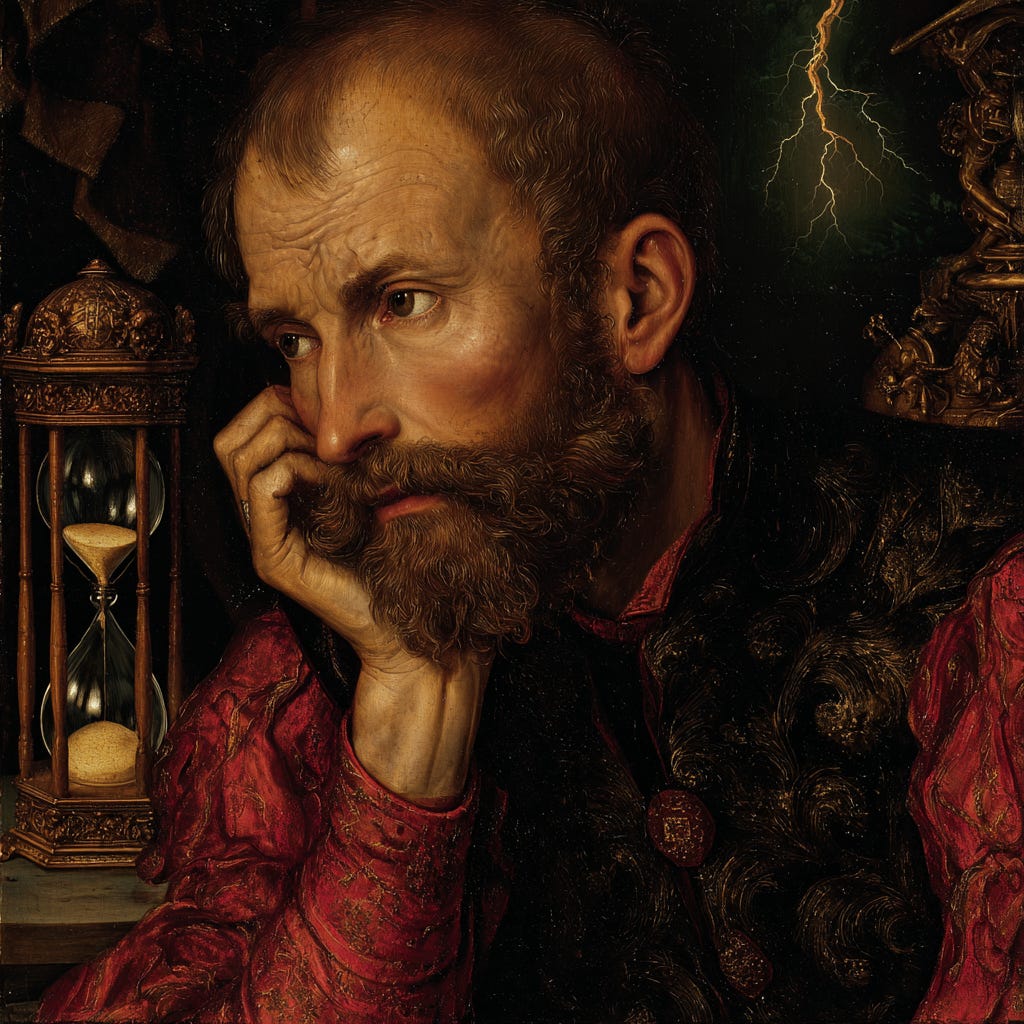
Socrates, on trial for corrupting the youth of Athens, tells the jury: “I know one thing: that I know nothing.” The line has been repeated so often it sounds quaint, almost harmless. But it was a provocation then, and it should be now.
If education is supposed to move us from ignorance to knowledge, what happens when the wisest man claims wisdom consists in knowing you have none? Do we ever really grow, or do we just circle endlessly around our unknowing?
That question is not academic. In a culture obsessed with optimization, we assume development moves up and to the right: start here, end there, level up. But beneath the noise lies a deeper, older puzzle: what does it mean to become anything at all?
Everything turns on time.
Aristotle thought time gave shape to becoming. An acorn grows into an oak because oakness is inscribed in its being. Human life works the same way: we move from potential to actuality, from raw capacity to flourishing. Virtue is not innate; it is cultivated through repeated acts until excellence becomes second nature.
In this view, education has direction. We aren’t reinventing ourselves endlessly; we’re uncovering what we already are. Time is the medium in which we fulfill our essence.
This is enormously attractive now, when so much feels unmoored. It reassures us there are better and worse ways of living, that there is something in human nature that can be nurtured into fullness. You can see why Aristotle is back in vogue among critics of modern anxiety: when everything feels destabilized, teleology promises a center that holds.
But this comfort has a cost. If the good life is predefined, what room is left for freedom? For reinvention? For rejecting inherited scripts? Aristotle assumes we know what flourishing is — or at least that it can be discovered — but what if the real task is creating meaning rather than uncovering it?
Enter Nietzsche, Heidegger, and Sartre, detonating Aristotle from within.
Humans, Heidegger says, are temporal beings — but without fixed essence. We are “thrown” into existence, tasked with choosing who to become against the backdrop of death. Time isn’t just the medium of development; it is the horizon that makes development possible.
Freedom here is absolute and terrifying. There are no natural blueprints, no guaranteed ends. To become someone is to act — to commit, to risk — knowing that every choice closes off other futures forever. Education, then, isn’t training for a stable role; it’s an encounter with openness itself. The teacher brings you to the “Clearing.”
But where, in Plato that Clearing was the Good, the True, and the Beautiful, in Heidegger it is “the mystery of being,” “the question of Being,” “the oblivion of being.”
Heidegger feels timely in a way Aristotle doesn’t. In an era of fractured identities, disrupted careers, and rapidly shifting technologies, many of us experience life less as unfolding nature than as radical improvisation. We are increasingly called upon to choose without precedent, to decide without guarantees.
And yet pure openness curdles into drift. Heidegger offers no guardrails, no wisdom traditions, no shared sense of the good. To do so would be to revert into metaphysics, something he dismisses as a fallen, derivative, and inauthentic mode of thinking. In privileging possibility, Heidegger risks collapsing education into endless self-creation — exhilarating at 20, exhausting at 40.
Hegel offers a middle-ground. Like Aristotle, he embraces development; like Heidegger, he denies fixed essences. But for Hegel, time is neither neutral container nor empty horizon. Time is transformation — the process through which Spirit becomes what it is by passing through contradiction.
Hegel explains something Aristotle and Heidegger both miss: why we experience our own philosophies in phases. The restless openness of youth, the settling into patterns in midlife, the periodic reinventions that unsettle us again. Education becomes less about arrival than about learning when to crystallize and when to dissolve.
The danger, of course, is that Hegel’s dialectic can be mistaken for progress. History may move, but not always forward; consciousness expands, but it can also regress. To live as if each stage guarantees transcendence is its own kind of teleology. In Hegel, History, not the individual, becomes the subject. From that macro-view, it remains Aristotelian. The acorn becomes an oak; the one-sided view eventually becomes Absolute self-knowledge at the End of History.
And then there’s Dōgen. The 13th-century Zen master writes, “Practice and enlightenment are one.” There is no gap between where you are and where you are going. Every moment of practice is complete.
At first glance this collapses the whole discussion. If each moment contains everything, what sense does it make to speak of development at all? But Dōgen’s point isn’t that change is an illusion; it’s that becoming is inseparable from being. Time is not a ladder but a circle: every step forward folds back into presence.
This is beautiful — and suspect.
It risks becoming what Rob Henderson calls a luxury belief: easier to affirm when you’re writing in a monastery than struggling to pay rent. Yet dismissing Dōgen entirely would be too easy. He reminds us that the obsession with becoming can mask an inability to inhabit what is. Perhaps growth and presence are not rivals but interdependent: without presence, growth is restless; without growth, presence is stagnant.
So where does that leave us?
Aristotle offers structure but risks rigidity.
Heidegger offers freedom but risks drift.
Hegel offers movement but risks complacency.
Dōgen offers presence but risks denial.
Education today, in an age of acceleration, cannot afford to pick one and discard the rest. We live amid collapsing traditions and proliferating possibilities.
Do we want education to anchor us, or to unsettle us? To reveal what we are, or to help us become what we are not yet? To prepare us for ends we can name, or to prepare us for ends we cannot imagine? Without answering these fundamental questions, we cannot adequately articulate why AI sycophancy is a problem, or how much viewpoint diversity is too much?
When I was younger, Heidegger thrilled me: the open horizon, the romance of freedom. As I’ve aged, Aristotle feels wiser: habits shape us more than we admit, and flourishing has a structure that can’t be endlessly reinvented. Lately, though, I keep circling back to Hegel. Maybe the point isn’t choosing between freedom and fulfillment but learning to navigate their alternation, to spiral through stages without clinging to any as final.
Time educates us whether we want it to or not.
Can we learn to read its shape?
 | A guest post by
|
This beautiful piece resonates with The Philosophical Jew's May 4, 2025 podcast (Ep. 5 - Media, Meaning, and Torah) where the guest, Rav Mo, illuminates his views on why the created world contains time and space - that these are both needed for movement and development (the universe's and ours) as a follow-on move to Gd's initial creation of imperfection, perhaps for Gd's own development from an initial perfect, and hence static, state (Malachi 3:6 Ki Ani Hashem Lo Shaniti- “Because I am God, I do not change.”). Rav Mo threads the needle to arrive at a deeper understanding of theodicy in this world as impelling further development. He refers to Rav Kook as a prior source, perhaps as a reflection on Rav Kook's view that the entire world is as an extension of divine perfection, possessing an inherent ability for constant improvement and growth.