

Unfolding Patterns
In Search of Aura with William Morris and Walter Benjamin


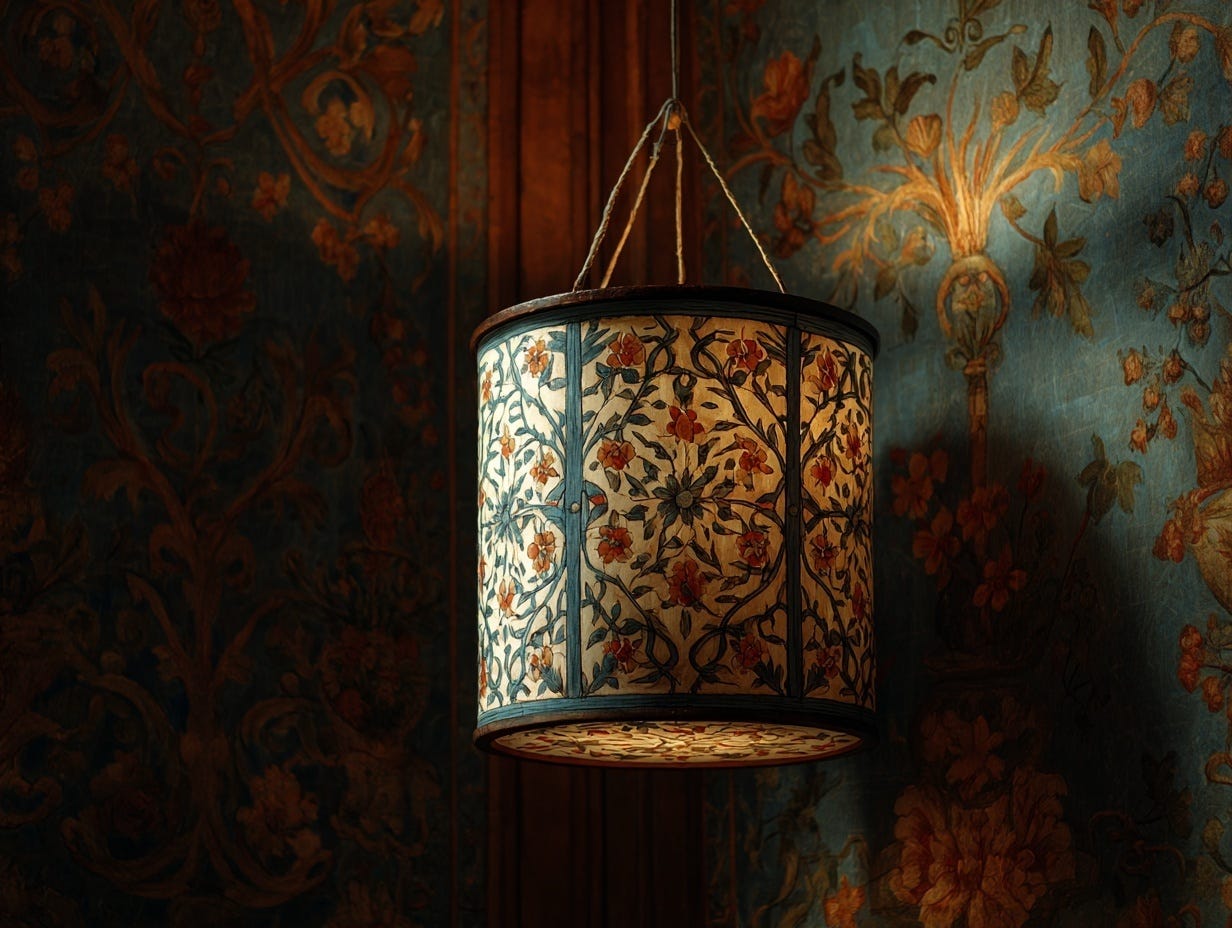
Our eight year old son is unfolding a paper lantern pattern on the kitchen table. His hands move slowly, with that particular quality of childhood attention: both excited and careful, urgent but precise. The pattern emerged from a do-it-yourself kit my mother brought back as a gift from a recent trip to Santa Fe, packaged with an ethos about building beautiful things. As the paper opens, I watch geometric shapes reveal themselves: intricate, particular, yet somehow universal in their logic.
I’m suddenly thinking about William Morris, although I haven’t thought about his work in years. The unfolding triggers his famous instruction: “Have nothing in your houses that you do not know to be useful, or believe to be beautiful.” I’m also thinking about how we choose what to add, not only to our homes and rooms but to our lives. Standing there, watching the work unfold, I’m caught by a question I can’t quite shake: what patterns are we living inside right now that we can’t yet see?
My mother found this design friendly kit in Santa Fe, a community organized around arts and craft in the midst of a timeless, majestic landscape. The patterned lantern seems to know what it’s for: making something worth having. To add something deliberately chosen to our home, to our life.
That unfolding on our kitchen table echoes another — one that began a century and a half ago, when a man tried to preserve meaning in the shadow of the machine.
William Morris stood at a different kind of threshold. The 1880s, when he designed patterns like Strawberry Thief — thrushes stealing fruit from his garden at Kelmscott Manor — marked the height of industrial manufacturing’s transformation of English life. Factories could reproduce patterns infinitely, cheaply, without the hand’s involvement. Morris watched this acceleration with deep ambivalence. He believed in beauty as a human right, in craft as dignified labor, in the home as a place where useful and beautiful things should dwell together. But the very mechanisms that could democratize beauty threatened to hollow it out.
What a paradox.
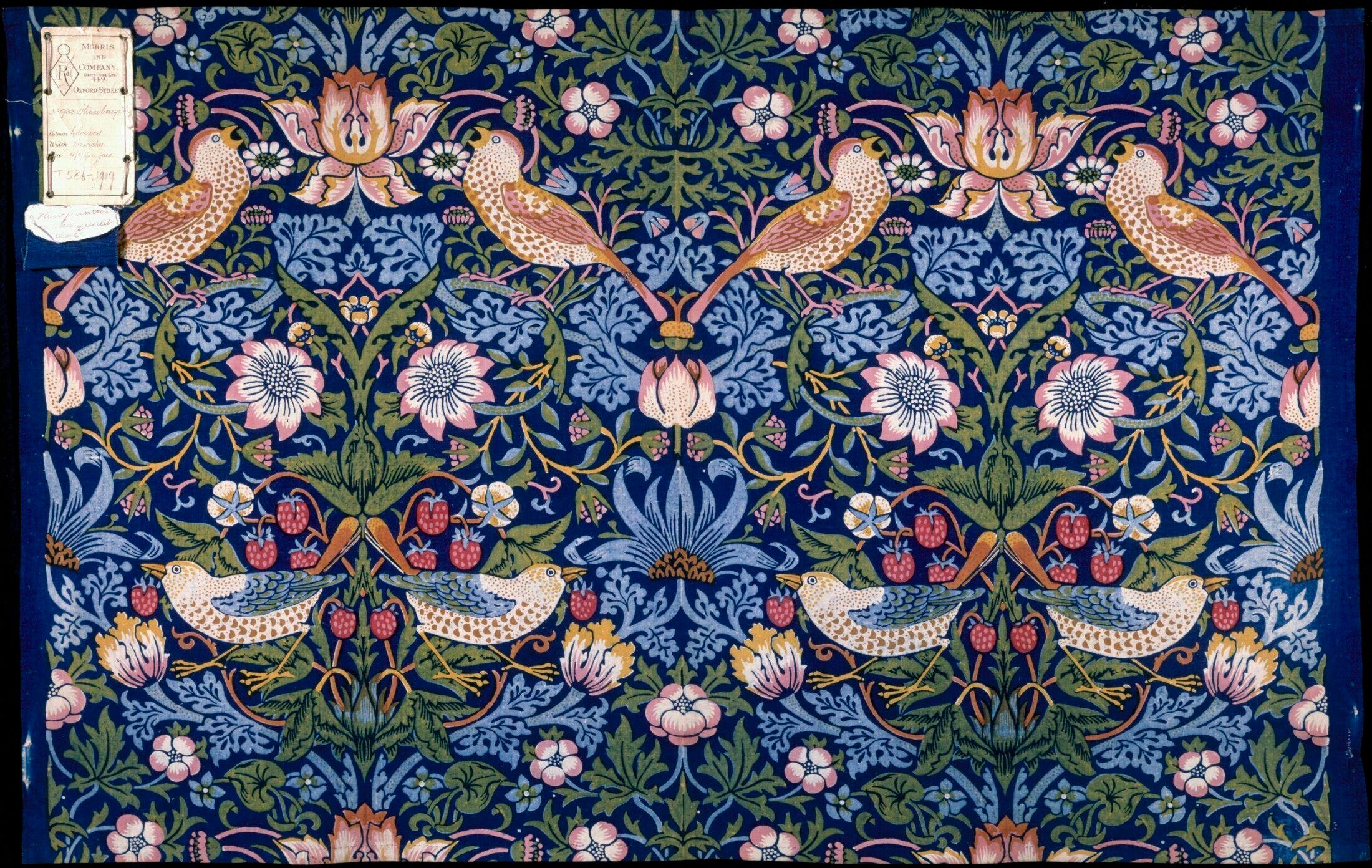
Morris chose an interesting response: he didn’t reject pattern. He went deeper into it. His workshops used complex printing techniques, like the indigo-discharge method for Strawberry Thief, that required the fabric to be dyed, bleached, and overprinted—a process so labor-intensive it almost resisted industrial replication. His patterns drew from medieval designs and direct observation of nature: willow branches, acanthus leaves, birds in strawberry plants. Each one particular, yet somehow universal in the way our son’s lantern pattern feels universal.
What drew me to thinking about Morris was wondering if the lantern pattern was his.
Morris was trying to hold something, a quality of attention, or a relationship between maker and made thing, something he worried that industrialization threatened to dissolve. He knew the thrushes in his garden. He watched them, sketched them, translated their movement into textile design through processes that kept his attention bound to theirs for months. The pattern that emerged carried that sustained looking, the trace of how that beauty came to be.
The world was changing faster than anyone could quite comprehend, and he was trying to establish what mattered before it disappeared entirely.
He was moving quickly because he had to loand took pause at the moment in which he found himself. As digital abstractions threaten to override concrete appreciations in our current landscape, I can’t help but be drawn to the similarities with his time.
Walter Benjamin, writing in the 1930s—decades after Morris’s death, decades before AI—tried to articulate what mechanical reproduction changed about art. He called it “aura”: that unique presence an artwork has in time and space, its here-and-now, its authenticity. A painting in a museum has aura. A photograph of that painting, reproduced in a book, does not. Not because the reproduction is necessarily wanting, but because something essential about presence—about being there, about the work’s embeddedness in a particular moment and place—cannot transfer.
At least this was the way Benjamin came to think about things.
However, Benjamin wasn’t purely nostalgic about this loss. He saw possibilities in reproduction: art could reach more people, serve different purposes, create new forms of perception. But he understood that something was genuinely lost, even if something else was gained. The question wasn’t whether to stop reproduction—that was already impossible. The question was: could we understand what we were trading?
Andy Warhol would add complex twists to much of this through his art.
Morris’s strawberry thieves carried aura—the trace of sustained attention, of months spent watching and sketching, of hand and eye working together through complex printing processes. What happens to aura when we move past mechanical reproduction to algorithmic generation? Benjamin worried about copies of originals. We’re facing something stranger: originals without originals, patterns that emerge fully formed from prompts, with no garden, no thrushes, no hand holding the pencil through months of observation.
It’s a curious place to be.
We’re moving so quickly—perhaps faster than Benjamin could have imagined, certainly faster than Morris. AI doesn’t just reproduce patterns—it generates them, endlessly, in response to prompts we’re still learning how to phrase. It folds possibilities at a speed that makes mechanical reproduction look leisurely by comparison.
I stand in our kitchen, watching our son unfold paper, wondering: if aura requires the here-and-now, the trace of making, the sustained attention—what does it mean to generate pattern without those things? Not copied from an original but invented in the moment, drawn from millions of images aggregated and folded into something new that has never quite existed before?
The patterns may be beautiful. They may even be useful. Do they carry aura? Can they? Does the concept of aura itself need to be reimagined? Or is that the wrong question—like asking whether a photograph should have the presence of a painting, when photography might create its own form of attention, its own way of being present?
Our son’s hands work the creases—each fold revealing what was hidden, creating new surfaces, new dimensions. The flat becomes architectural. I watch complexity emerge not from addition but from continuous folding and refolding: a sheet of paper becoming a three-dimensional form that will hold light, cast shadows, create pattern on his bedroom walls, hanging neatly over his bed.
Deleuze wrote about the baroque as an art of infinite folds, ornamentation that refuses simple surface. The Fold is dense but revealing. For Deleuze, the fold was the logic of complexity itself, the way matter and meaning continually shape each other. It wasn’t merely decoration. Standing here, I see what he meant. This lantern doesn’t just have a pattern—it is pattern, emerging through the very act of folding. And I think: this is what AI does too, isn’t it? Infinite folding, endless variation. Baroque in its excess. Ask it for a William Morris–style pattern and it will give you dozens, each one a different folding of the same visual grammar, each one plausible, each one emerging instantly.
But something has changed in the relationship between folder and folded. Morris stood in his garden. Benjamin stood in museums. I stand in my kitchen watching paper unfold in our son’s hands, and I’m trying to understand what we’re trading.
I think about what we choose to add to our homes. Morris’s instruction feels more urgent now, not less. “Have nothing in your houses that you do not know to be useful, or believe to be beautiful.” The knowing has become complicated. When everything can be generated, when every style can be approximated, when patterns unfold infinitely at our request—what does it mean to know something is beautiful? What does it mean to believe in its utility?
Our son will inherit a world where pattern generation is instantaneous—where the labor Morris fought to preserve, the hand’s involvement, the eye’s attention, the sustained relationship between maker and made thing, has been largely abstracted away. He’ll be able to prompt into existence any pattern he can imagine, and many he can’t yet conceive. The question isn’t whether this is good or bad. The question is: what will he understand about choosing? About adding deliberately to his life rather than accumulating what unfolds at his request? Curation takes on an entirely new form of vitality.
Perhaps aura itself is evolving—emerging not from the trace of the hand, but from the trace of intention, from the quality of the prompt, from the discernment of the chooser rather than the maker.
I’m not sure.
I don’t have an answer, but I think Morris’s choice shows us something. He made a decision—to go deeper into craft, to insist on quality even as it became economically untenable, to keep drawing from his garden even as factories churned out approximations. It was a choice that contained its own contradictions: his beautiful things became expensive, available only to those who could afford sustained attention translated into textile.
But maybe the value wasn’t in resolving the contradiction. Maybe it was in holding the question—in continuing to notice the thrushes, to sketch the willow branches, to care about the particular curve of an acanthus leaf even when, especially when, everything could be mechanically reproduced.
Benjamin saw this too: the question wasn’t to stop reproduction but to understand what we were trading. To name aura even as it faded. To recognize that new forms of perception might emerge, but only if we understood what the old forms had given us.
What new forms of perception are emerging? What new styles of creating?
The lantern kit sits on our kitchen table, partially unfolded. We’ll finish it together, hang it in our son’s room, add it deliberately to our home. It will cast patterned light on his walls—shadows that fold and unfold as he moves through his space.
I’ll think of Deleuze and Morris and Benjamin and the light as an angel.
I wonder what patterns he will learn to see, the ones that organize his perception, shape his attention, structure his sense of what’s possible. What patterns exist right now that we can’t yet name because we’re living inside them? How will he learn to choose—to discern between what’s merely generated and what carries aura, that quality Morris and Benjamin both sought in different ways, that sense of something present, attended to, itself?
Morris stood at the beginning of mass reproduction, trying to articulate what mattered before it disappeared. Benjamin stood in the middle, naming what was being lost and gained. We stand at the beginning of mass generation, and I wonder if the question is similar: not whether we can make patterns, but whether we can sustain the quality of attention that makes patterns mean something. Whether we can teach our children—watching them unfold paper with careful excitement—to notice what’s worth bringing into their homes, into their lives, into the world they’re inheriting. Is that meaning today?
The lantern waits, half-folded. The pattern, half-seen. My mother intended for our son to enjoy the craft that would cast a light that would illuminate his room. What unfolds next, I suppose, will depend on what we choose to attend to.
 | A guest post by
|
Beautiful! This resonates with the sense of loss I felt in reading William Golding’s novel “The Inheritors”. Golding endowed his presumably Neanderthal characters with an inter-mental non-verbal connection that the successor species, presumably Homo Sapiens, lacked, depriving the latter of communally grokking a situation even as they were empowered by individualistic cognitive capabilities which could only be transmitted serially via language. We can often sense an aura which we are not able to put into words. This makes me wonder if our inheritor AIs trained on our words but without our senses will be even further impoverished as they move “beyond” our intelligence.