


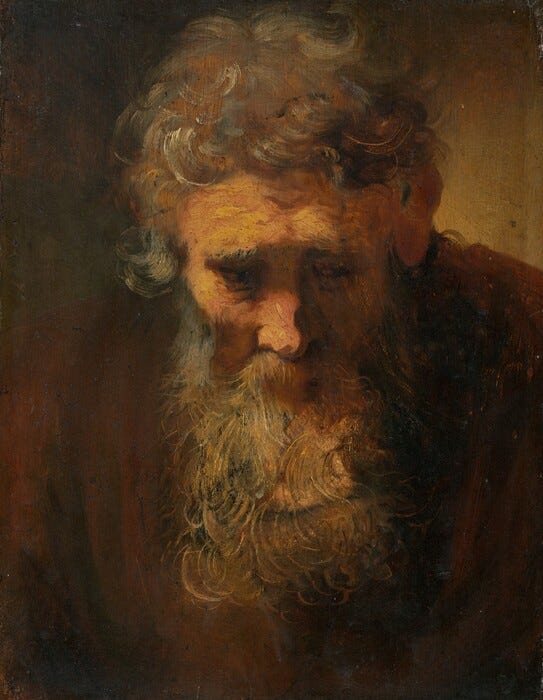
In 1984, the National Gallery of Art in Washington changed the attribution of Study of an Old Man to “Style of Rembrandt.” The collector Peter Widener had bought the painting as a Rembrandt in 1905. A 1913 catalog accepted the attribution and praised its brushwork. Decades of scholarly doubt followed. The old man with his gray beard remained in the picture; the name of the painter had become uncertain.
The museum’s scholarly account preserves this history, including the earlier attribution and the reasons for rejecting it. Now imagine a digital guide answering a question about the painting by retrieving only the 1913 catalog. It could supply an authentic source for an attribution the museum had already abandoned. The quotation would be accurate. The answer would misrepresent the museum’s judgment.
In such an answer, an earlier judgment would be separated from its correction, allowing a record of what people once believed to pass for the museum’s current view. The same error is possible with a newspaper report that was later corrected, or the minutes of a meeting in which a proposal was discussed and rejected. Understanding such records requires knowing what became of the statements they contain.
This problem gives an unexpected relevance to a discussion in the Babylonian Talmud, the vast collection of rabbinic law and debate. In tractate Temurah, Rav Yosef, a Babylonian sage, encounters two apparently contradictory rules about the timing of sacrificial offerings. He proposes resolving the difficulty by removing the phrase “the libation offering” from one of the teachings. Another sage, Rav Dimi, hears an explanation that would make the deletion unnecessary. The rules concern different circumstances: one applies to libations accompanying a sacrifice, the other to libations offered independently.
Rav Dimi proposes sending Rav Yosef a letter with the instruction ולא תיסמי, “do not delete.” At this point, the Talmud interrupts its discussion of sacrifices to raise a question about the letter itself. The teaching belongs to the Oral Torah, the body of Jewish law and interpretation meant to be transmitted through speech and study. Is Rav Dimi permitted to write it down? The objection is expressed with startling force in a saying cited by the Talmud: “those who write down legal teachings are like those who burn Torah.” (Temurah 14b)
The survival of this warning in a written book might look like a simple inconsistency. Yet the discussion already recognizes the conflict between a rule about transmission and the need to keep the tradition alive. It considers whether a new teaching might warrant an exception, then describes sages consulting written collections of religious exposition. Their justification is that a rule may have to be suspended to prevent Torah from being forgotten. The written Talmud preserves both the objection to writing and the argument for making an exception.
Two kinds of preservation are at issue here. Rav Dimi’s explanation would preserve words that Rav Yosef proposes to remove. Writing the explanation would help transmit it, while crossing a boundary the tradition has established for its own protection. In both cases, fidelity requires a judgment about how the inheritance should be treated. Copying the two rules exactly would leave their apparent contradiction unresolved. Rav Dimi supplies the distinction that allows a later reader to understand why both deserve to survive.
Derrida examines the connection between preservation and authority in Archive Fever. An archive, in his account, takes shape through decisions about what to collect, how to arrange it, and who may consult and interpret it. Its material form matters as well: the means available for recording and retrieving information help determine what can be preserved. These decisions bear on the future, since they shape the evidence later generations will encounter and the questions they will be able to ask.
Seen in these terms, the museum guide’s error belongs to the history of the archive as much as to the accuracy of a particular answer. Making a collection accessible involves further acts of selection and interpretation. A description, a search result, or an answer assembled from several documents gives the reader a particular route through the evidence. Each can reveal relationships that would otherwise be difficult to discover. Each can also obscure the difference between a statement and the judgment subsequently made about it.
An early rabbinic text addresses this distinction. Tractate Eduyot asks why opinions that have been rejected continue to be recounted. The question arises from the purposes of a legal tradition. If students need to learn which rules to follow, preserving unsuccessful arguments might seem an unnecessary burden, or even a source of confusion.
The opening cases make the question more pointed by recording positions of Hillel and Shammai, two revered teachers, that the sages accepted from neither. Why continue to teach these views? The Mishnah answers:
ללמד לדורות הבאים שלא יהא אדם עומד על דבריו
“To teach future generations that a person should not insist on his own position.” (Eduyot 1:4)
The rejected opinions have acquired an educational value through their rejection. Students learn something about authority by encountering the limits of people they are taught to respect. The passage associates the standing of a great teacher with the ability to yield, giving later generations a reason to examine their own attachment to their judgments.
This is a demanding use of institutional memory. A collection that retained only accepted conclusions would offer a misleading picture of how knowledge develops. It would conceal the disagreements and revisions through which those conclusions were reached. Keeping an error available for study allows successors to understand why it once seemed persuasive and what eventually made it untenable. In the Mishnah’s account, it can also teach them how to behave when their own views are challenged.
The following passages offer other reasons for preserving rejected opinions. A later court may have grounds to rely on a minority view, subject to the rules governing judicial authority. Its rejection therefore need not exhaust its possible uses. Rabbi Yehudah considers a different situation: someone arrives claiming, “This is the tradition I received.” The record enables others to identify the opinion and explain its standing. The person may remember the teaching correctly while misunderstanding its authority. (Eduyot 1:5–6)
These explanations give the same material several possible functions. An opinion can serve as a lesson in intellectual conduct, remain available for a future legal decision, or help identify the provenance of a disputed claim. To preserve it adequately requires transmitting its place in the argument. A student who remembered every opinion while forgetting which had been rejected would have failed to learn something essential.
The earlier attribution of Study of an Old Man illustrates the distinction. It no longer answers the question “Who painted this?” It remains relevant to “How has this painting been understood?” Removing the attribution from the record would make the second question harder to answer. Presenting it as current would mislead someone asking the first. Its value depends on the inquiry in which it is being used.
A digital guide that draws on the collection must take account of this difference. So must any system that assembles an explanation from several sources. A witness’s recollection, a curator’s inference, and a disputed identification can all belong in an answer, provided their different standing remains clear. A link to an authentic document is insufficient if the document cannot support the claim being made.
Museums and libraries already devote substantial scholarly labor to establishing these distinctions. The question is how much of that work remains visible to the public.
The Talmud’s account of Rav Dimi leaves his letter unsent, so far as we know. What survives is the proposal to write it, together with the disputed teaching, the explanation that would prevent its deletion, and the objection to putting that explanation in writing. Later readers can examine the difficulty as well as the proposed solution. They inherit the reasons for the judgment and can consider those reasons for themselves.
The National Gallery’s account lets us follow the attribution back to Widener’s purchase and the catalog that accepted it. A “context layer” must keep that earlier attribution connected to the evidence that overturned it, so a reader can distinguish what the catalog records from what the museum now endorses. Without that connection, a digital guide can put Rembrandt’s name back on a painting the museum has ceased to call his.
If you run an archive or museum and are looking for a partner that can help you make your collection accessible with AI while preserving the scholarship and context that give it meaning, I would love to talk.
Learn more here and reach out: zohar@lightningstudios.ai